teleporting into the future and robbing yourself of retirement projects
I'm going to make this a really quick one because this is doing the rounds, and whilst I've tweeted about it, it's time to dig in.
Pragmatic Engineer's @GergelyOrosz is on a "secret email list" of agentic AI coders, and they're starting to report trouble sleeping because agent swarms are "like a vampire."
— TBPN (@tbpn) February 4, 2026
"A lot of people who are in 'multiple agents mode,' they're napping during the day... It just really is… pic.twitter.com/slsPgCfkKw
What Gergely is articulating here is something that I and everyone else went through a year ago who were paying attention. AI enables you to teleport to the future and rob your future self of retirement projects. Anything that you've been putting off to do someday, you can do it now.
To quote a post I authored almost eight months ago:
It might surprise some folks, but I'm incredibly cynical when it comes to AI and what is possible; yet I keep an open mind. That said, two weeks ago, when I was in SFO, I discovered another thing that should not be possible.
Every time I find out something that works, which should not be possible, it pushes me further and further, making me think that we are already in post-AGI territory.
- https://ghuntley.com/no/ (dated July 2025)
And another post back in September 2025:
It's a strange feeling knowing that you can create anything, and I'm starting to wonder if there's a seventh stage to the "people stages of AI adoption by software developers"
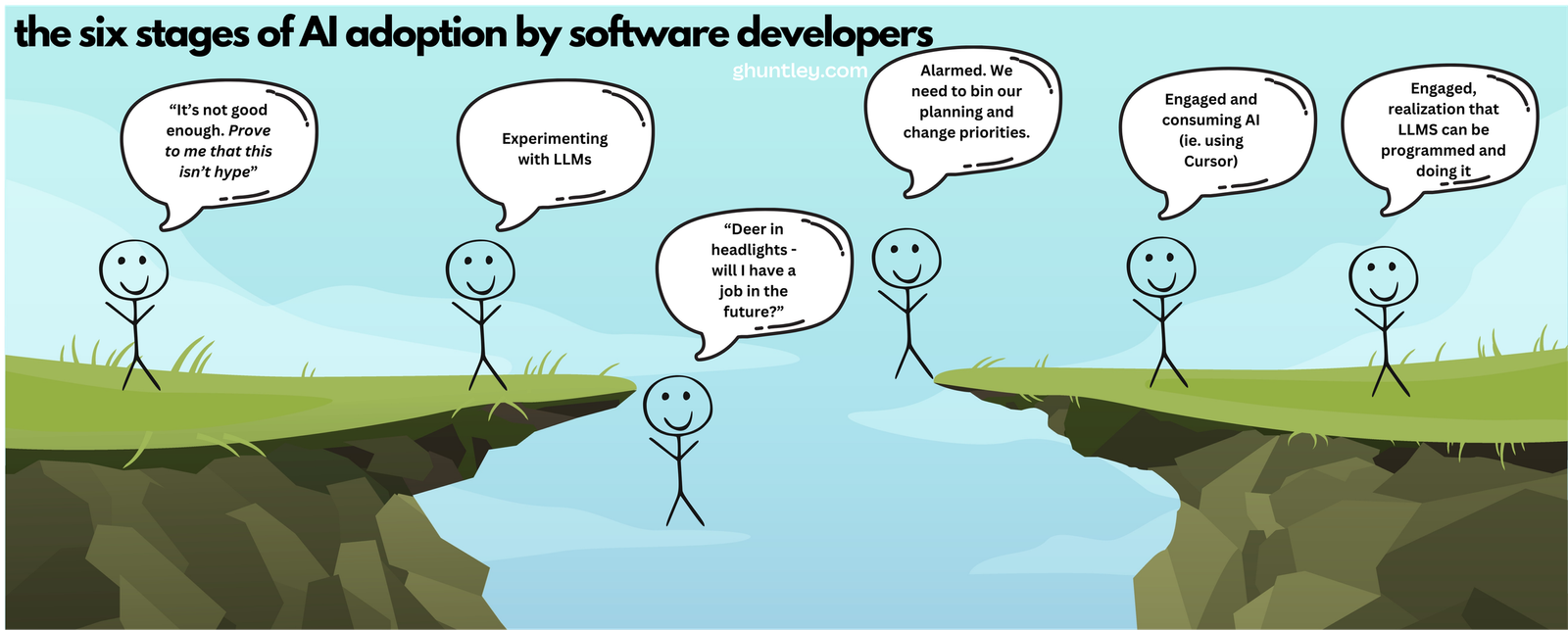
whereby that seventh stage is essentially this scene in the matrix...
In the previous 12 months, I've cloned SaaS product feature sets of many different companies. I've built file systems, networking protocols and even developed my own programming language.
From my perspective, nothing really changed in December. The models were already great, but what was needed was a time of rest - people just needed to pick up the guitar and play.
 Geoffrey Huntley
What makes December an inflection point was the models became much easier to use to achieve good outcomes and people picked up the guitar with an open mind and played.
Over the last couple of weeks, I've been catching up with software engineers, venture capitalists, business owners, and people in sales and marketing who are all going through this period of adjustment.
Universally, it can be described as a mild form of creative psychosis for people who like to create things. All builders who have an internal reward function of creating things as a form of pleasure go through it because AI enables them to just do things.
 Geoffrey Huntley
Everyone who gets AI goes through it, and it typically lasts about two to three months, until they get it out of their system by completing all the projects they were putting off until retirement.
Perhaps it could be described as a bit of a reset, similar to what happened during COVID-19, when people were able to reassess what they wanted to do in life.
It's a coin flip, really, because people are either going to commit more to their current employer if they are an employee, but on the other side of the coin, they're realising they are no longer dependent on others as much to achieve certain financial outcomes.
Perhaps this is the tipping point where more people throw their hats in and become entrepreneurs.
People with ideas and unique insight can get concepts to market in rapid time and be less dependent on needing others' expertise as the world's knowledge is now in the palms of everyone's hands.
Technologists are still required, perhaps it's the ideas guys/gals who should be concerned as software engineers now have a path to bootstrap a concept in every white collar industry (recruiting, law, finance, finance, accounting, et al) at breakneck speed without having to find co-founders.
- From Feb 2025
I guess I need to wrap this up now, but I will say this:
I've written about how some people won't make it, and I've spent the last year talking about this, pleading with people to pick up the guitar and play...
If you're having trouble sleeping because of all the things that you want to create, congratulations.
You've made it through to the other side of the chasm, and you are developing skills that employers in 2026 are expecting as a bare minimum.
The only question that remains is whether you are going to be a consumer of these tools or someone who understands them deeply and automates your job function?
 Geoffrey Huntley
go build yourself an agent and taste building in the recursive latent space
Trust me, you want to be in the latter camp because consumption is now the baseline for employment.
After you come out of this phase, I hope you get to where I am, because just because you can build something doesn't mean you necessarily should. Knowing what not to build now that anything can be built is a very important life lesson.
ps. socials
📰 What @GergelyOrosz is articulating here is something that I and everyone else went through a year ago who were paying attention. AI enables you to teleport to the future and rob your future self of retirement projects. Anything that you've been putting off to do someday, you… pic.twitter.com/OXm9VvXhdZ
— geoff (@GeoffreyHuntley) February 5, 2026